Why Do Older Dogs Sleep More? Normal vs. Concerning Signs
Share
Why do older dogs sleep more is the first question most owners ask when they notice their dog spending twelve, fourteen, or sixteen hours a day on their bed. The change happens gradually — the dog that used to meet them at the door now lifts their head and goes back to sleep. The morning walk that used to start at a sprint now begins with a slow stretch and a long pause before moving. Senior dogs typically sleep 14 to 18 hours a day, significantly more than the 8 to 13 hours an adult dog needs. For large breeds the number can reach 20 hours. In most cases increased sleep is entirely normal. Knowing why do older dogs sleep more — and recognising the difference between normal aging and a genuine concern — is the most useful thing an owner of an aging dog can do.
Why aging changes how much dogs sleep
A senior dog's body works harder to do less. Joints that moved freely at three require more effort at ten. Muscles that recovered overnight now need longer. The metabolic shift that comes with age means an older dog burns energy differently — tasks that were effortless now carry a real physical cost, and the body responds by demanding more recovery time. This is the core reason why do older dogs sleep more as the years pass — the sleep is doing real restorative work between efforts, not signalling that something is wrong.
A younger dog might bounce back from a long walk in an hour. A senior dog doing the same walk needs the rest of the afternoon. Owners who understand why do older dogs sleep more stop counting nap hours and start paying attention to what happens when their dog wakes up — because engagement when awake tells the real story.
Senior dog sleeping all day — what is normal
Senior dog sleep patterns shift in ways that can look alarming but are entirely typical. The number of hours matters less than the quality of engagement when a senior dog is awake. A dog sleeping fourteen hours a day but waking up alert, eating with appetite, and responding to their leash or a treat with clear interest is a dog whose rest is working properly.
Normal patterns in a senior dog include:
- Sleeping deeply through the day but waking quickly when something genuinely interests them
- Moving more slowly than before but still initiating movement toward food, people, or familiar stimuli
- Choosing softer surfaces and warmer spots as preferred rest locations
- Settling faster at night than they did at younger ages
- Showing morning stiffness that eases within minutes of moving around
These are behavioral shifts, not warning signs. They reflect a dog whose body has learned to protect its energy — which is exactly what a healthy aging system does. Senior dog sleep patterns naturally shift toward more rest and shorter active windows. That shift alone is not a problem.
Old dog sleeping more and less active — when to pay attention
Increased sleep becomes worth investigating when it changes the dog's engagement pattern rather than just their rest hours. A senior dog that sleeps more but still shows interest in food, people, and their environment is aging normally. A dog that is sleeping more and less active across the board — food, movement, and interaction — is showing a different pattern worth monitoring.
Understanding why do older dogs sleep more helps here — a gradual increase over months is a normal aging trajectory. A sharp increase over days is a different signal. Signs worth watching closely include:
- A sudden increase in sleep beyond the dog's established baseline
- Consistent disinterest in food across multiple meals
- Difficulty rising that goes beyond normal morning stiffness
- Confusion or disorientation after waking
- Restlessness at night combined with heavy daytime sleep — this can signal disrupted sleep cycles rather than normal aging
None of these are automatic emergencies. But combined with increased sleep they are changes worth tracking closely.
How environment drives senior dog sleep quality
One factor most owners overlook is how much the physical environment affects a senior dog's rest. A dog sleeping on a flat mat that compresses under their weight is not getting restorative sleep — they shift position constantly through the night, never reaching deep sleep, and wake up stiff and tired. A dog on a cold hardwood floor loses body heat throughout the night and wakes earlier and more fatigued than they went to sleep.
The surface a senior dog sleeps on directly affects how they feel when they wake up. High-density foam that holds its shape under sustained weight allows an aging dog to stay in one position long enough to reach genuine deep sleep. A raised surface keeps them away from cold drafts at floor level. A bolstered edge gives them something to press against, which signals safety and reduces the low-level alertness that interrupts rest throughout the night.
Owners who upgrade their senior dog's sleeping environment consistently notice the same results — their dog settles faster, stays down longer, and moves more freely in the mornings. Understanding why do older dogs sleep more is only half the picture. The other half is making sure the sleep they get is actually restorative.
Small environmental changes with visible results
Beyond the bed itself, a few simple changes make a consistent difference for senior dogs that seem to be sleeping more than usual:
- Place the bed away from drafts, air conditioning vents, and exterior walls
- Add a non-slip rug between the bed and any hard flooring so the dog moves confidently at night
- Keep the bed in a low-traffic area where the dog is not repeatedly disturbed during deep sleep cycles
- Ensure the bed height suits the dog's mobility — a surface that is difficult to step onto gets avoided entirely
- Keep the sleeping area at a consistent temperature — senior dogs are more sensitive to cold than younger dogs and wake more often when chilled
The difference the right bed makes
A senior dog spending fourteen to eighteen hours a day lying down is spending the majority of their life on their sleeping surface. The quality of that surface is not a luxury consideration — it is a daily quality-of-life factor with visible results.
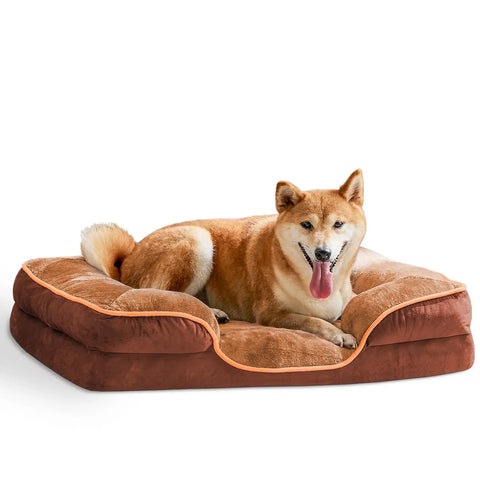
The DreamRest™ Orthopedic Memory Foam Dog Bed uses a solid high-density viscoelastic core that holds its shape under sustained weight, a waterproof TPU liner for easy maintenance, and a machine-washable cover for senior dogs with incontinence or heavy shedding. For senior dogs that curl when they sleep, the Calm-Cloud™ Plush Donut Dog Bed provides a heat-retaining bolstered enclosure that supports the nesting instinct and keeps aging dogs warmer through the night.
Both are built specifically for what a senior dog needs from a sleeping surface — not what looks good in a product photo.
Browse the full Dog Comfort & Calm collection →