Dog Ramp for Trucks: Pickup, Semi Cab & Side-Door Access
Share
The right truck dog ramp depends on where your dog loads. For a tailgate or truck bed, you want a long ramp that clips to the tailgate latch so it can't slide. For a side door or a semi cab — where there's no latch to anchor to — you want a freestanding ramp with an adjustable height that reaches a high step. Match the ramp to the entry point and a stiff senior dog walks up instead of refusing.
Trucks create a problem ordinary pet ramps were never built for: height. A standard 60-inch ramp is fine against a car bumper. Put it against a lifted pickup tailgate sitting around 34 inches off the ground and the climb jumps to roughly 34 degrees — too steep for an older dog to walk up with confidence. A semi cab or a lifted side door sits higher still. The fix isn't a longer ramp alone; it's the right ramp for the specific way your dog gets in.
Quick pick: match the ramp to the entry point
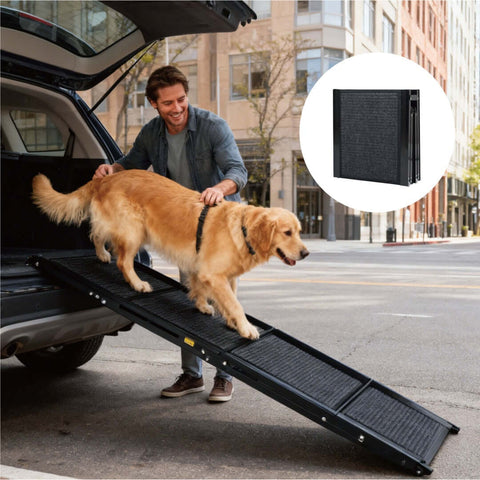
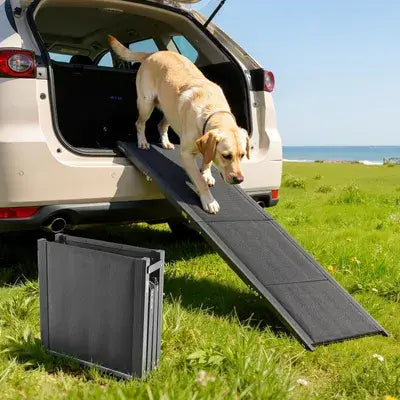
Loading at the tailgate or into the truck bed? You have a latch to anchor to. Use a long ramp that clips on so the base can't shift when your dog pushes off at the top — the TrailRamp™ — our extra long dog ramp for trucks (71″, clips to the tailgate latch).
Loading through a side door, or up into a semi cab? There's usually no latch, and the step is high. Use a freestanding ramp with an adjustable height that reaches it — the Heavy Duty Dog Ramp (71″, adjustable 18–58″, non-slip felt surface).
Compare both in the dog ramps for cars, SUVs & trucks collection.
Why truck height changes everything
The steeper a ramp sits, the harder a dog has to push through stiff hips and shoulders to reach the top. Senior dogs read that angle before they place a single paw — they stop, look back, and refuse. Length is what flattens the angle. Going from a 60-inch ramp to a 71-inch ramp against a 34-inch tailgate drops the climb from about 34 degrees to about 29 degrees. Those few degrees are often the difference between a ramp your dog walks up and one that sits unused in the garage.
But length only solves the angle. On a truck you also have to solve stability — and that's where the entry point matters.
If you want the full length-by-height math — including how to measure your own tailgate or door sill in 60 seconds — it’s covered step by step in our guide to how long a dog ramp should be.
Side-door and semi-cab access: the no-latch problem
A tailgate gives you something to clip to. A side door or a semi cab usually doesn't. The step is also higher than a tailgate, and the ground beside a cab can be uneven. That combination rules out a ramp that depends on a tailgate hook to stay put.
For side-door and cab loading, prioritise:
- Adjustable height that reaches a tall step — a fixed-height ramp built for a 34-inch tailgate won't comfortably serve a higher cab entry.
- A freestanding base that holds position on the surface beside the truck without needing to clip onto anything.
- A genuine grip surface. Molded plastic ridges turn slick the moment it rains in a parking lot; a bonded non-slip surface keeps traction wet or dry.
- Enough width for a large dog to walk straight up without feeling the edges.
Always measure first. Measure from the ground to the lip of the step your dog actually uses, then choose a ramp whose height range covers it with room to spare. A cab or lifted side door commonly sits well above tailgate height, so don't assume a tailgate-length ramp will reach.
Tailgate and truck-bed loading: anchor it down
If your dog loads over the tailgate or into the bed, a sliding ramp is more dangerous than no ramp at all. Here the priority flips to anchoring:
- A clip or carabiner to the tailgate latch so the base stays locked when a heavy dog pushes off at the top.
- A rigid center fold with locking hinges — no flex at the joint when a large breed steps directly on it.
- Length matched to the bed/tailgate height so the angle stays walkable.
What to look for in any truck ramp
- Length vs. your real height. Longer ramp = shallower, more walkable angle. Measure the step, don't eyeball it.
- Weight capacity above your dog's weight. A big senior dog mid-climb loads the surface harder than its standing weight.
- Surface grip that works wet. Trucks live outdoors — rain is the real test.
- How it folds and where it stores. A long ramp behind a back seat or in a bed is fine; in a small cab it isn't. Check folded size against your space.
- One-person handling. You'll often be positioning it solo with a dog already waiting.
For how these criteria play out across every major ramp type — aluminum quad-fold, telescoping, resin, budget mesh — see our best dog ramps for large dogs comparison.
For the full range of mobility support beyond ramps, see the senior dog joint & mobility collection.
The two Wagisk truck ramps, side by side
Both are aluminum, both hold 250 lbs, both extend to 71 inches. They differ in how they anchor and how high they reach — which is exactly the choice above.
| TrailRamp™ Extra Long | Heavy Duty Dog Ramp | |
|---|---|---|
| Best for | Tailgate & truck-bed loading | Side door, semi cab, high steps, SUVs |
| How it anchors | Steel carabiner to tailgate latch | Freestanding; adjustable 18–58″ |
| Extended length | 71″ | 71″ |
| Width | 19.3″ (wide track) | 17″ |
| Weight capacity | 250 lbs | 250 lbs |
| Ramp weight | 20.3 lbs | 17.6 lbs |
| Surface | Anti-tear fiber traction | Non-slip felt |
| Fold & storage | Folds to 19.3 × 19.5 × 6.0″ | Quad-fold, compact |
| Price | $179.95 | $169.95 |
Shop the TrailRamp™ Extra Long Shop the Heavy Duty Ramp
Both ramps, with current specs and pricing, live in our dog ramps for cars, SUVs & trucks collection.
How high is the step your dog loads into?
Every truck is different, and the one number that decides the ramp is the height from the ground to the exact step your dog lands on — not the truck's size or its lift kit. A tailgate gives you a latch to clip to; a side door or a cab almost never does, and it usually sits higher. Here are the ranges we see most often. Treat them as a starting point and measure your own, because a few inches changes which ramp reaches.
| Where your dog loads | Typical height to the landing | Anchoring | Ramp that reaches it |
|---|---|---|---|
| Standard pickup tailgate | ~30–34″ | Tailgate latch to clip to | TrailRamp™ (71″, clips on) |
| Lifted pickup tailgate | ~34–40″ | Tailgate latch to clip to | TrailRamp™ (71″, clips on) |
| SUV or crossover cargo floor | ~28–32″ | Hatch sill, no latch | Heavy Duty, set to the sill |
| Pickup side door with a running board | Board ~16–22″, then a step up | No latch | Heavy Duty, ramped to the board |
| Lifted truck side door / cab floor | ~28–40″+ | No latch | Heavy Duty (adjustable 18–58″) |
| Semi cab — lowest usable step or sleeper sill | ~18–30″ (more steps stacked above) | No latch | Heavy Duty (adjustable 18–58″) |
Loading through a semi cab or a high side door
This is the entry point most pet ramps ignore, and it's where owners get pointed to the wrong tool. A tailgate ramp clips to a latch and forgets about it. A semi cab or a lifted side door hands you three problems at once: there's nothing to clip to, the step is higher than a tailgate, and the ground beside the truck — a truck stop, a gravel shoulder, a job site — is rarely flat. A clip-on ramp can't solve any of those.
For side-door and cab loading, a freestanding ramp with an adjustable top height is the right shape of tool. A few things make it work in the real world:
- Set the height to the step, not the truck. A semi is a stacked set of steps, not one lip. Aim the ramp at the lowest usable step or the sleeper-cab door your dog can land on, and set the ramp's top to that height — you're not trying to reach the cab floor in one climb.
- Put the base on the firmest flat spot you can find. On loose gravel, press the feet down until they bite; on a slope, angle the ramp so the climb runs slightly uphill rather than sideways, which keeps a dog from drifting off the edge.
- Steady it the first few times. Because nothing clips it in place, keep a hand on the ramp and your dog on a short lead until they trust the surface. A wobble at a truck stop is exactly what makes a dog quit.
- Pick a grip surface that works wet. Painted running boards and molded plastic ridges turn slick in the rain; a bonded non-slip surface holds either way.
The Heavy Duty Dog Ramp is the one we point side-door and cab loaders to for exactly this reason: it stands on its own, adjusts from 18 to 58 inches to meet a high sill, and runs a non-slip felt surface. If your dog only ever loads at a fixed tailgate, the clip-on TrailRamp™ Extra Long is the simpler pick.
The honest limits
A ramp removes the jump — it doesn't remove every catch, and it's fair to know these before you buy:
- A cab floor can sit higher than any single ramp comfortably reaches. On a tall semi or a heavily lifted truck, the realistic target is the lowest step or the sleeper door, not the very top. Measure the landing you can actually aim for.
- Freestanding means you're the anchor. On gravel or a slope, a side-door ramp isn't clipped to anything, so it needs a hand and a short lead until your dog is confident. That's the trade you accept for reaching a step with no latch.
- A 71-inch ramp is genuinely long and around 18–20 lbs. Setting it up solo at a roadside takes a moment each time. If every load is at the same tailgate, a clip-on ramp is less to handle.
- No ramp works on a dog that hasn't been shown it. Introduce it flat on the ground first, with treats and no pressure, before the first climb into a cab. The hardware is the easy part.
And a ramp only changes the climb, not the dog. If an older dog that used to load fine is suddenly hesitating, slower, or refusing a step it managed last month, it's worth a quick word with your vet about what's comfortable for them right now — the ramp makes the jump optional, but only your vet can read what's behind the change.
Frequently asked questions
What dog ramp do I need for a pickup truck?
It depends on where your dog loads. For the tailgate or truck bed, use a long ramp that clips to the tailgate latch so it can't slide — the TrailRamp™ Extra Long (71″) is built for that. For loading through a side door, use a freestanding ramp with an adjustable height that reaches the step, like the Heavy Duty Dog Ramp (adjustable 18–58″). Measure from the ground to the step before choosing.
How do I get my dog into a semi truck cab?
A semi cab entry is high and has no tailgate latch to anchor a ramp, so a clip-on tailgate ramp isn't the right tool. Use a freestanding ramp with an adjustable height that covers the cab step (measure it first — cab steps commonly sit well above tailgate height). The Heavy Duty Dog Ramp adjusts from 18 to 58 inches and stands on its own beside the cab, with a non-slip felt surface for grip in a parking lot.
What's the difference between a side-door ramp and a tailgate ramp?
A tailgate ramp can clip onto the latch, so anchoring is the priority. A side door usually has nothing to clip to and the step is higher, so the priority becomes adjustable height and a base that holds position on its own. That's why we point tailgate/bed loading to the TrailRamp™ and side-door/cab loading to the Heavy Duty Ramp.
How long should a dog ramp for a truck be?
Long enough to keep the climb walkable. A lifted pickup tailgate around 34 inches high pairs well with a 71-inch ramp, which holds the angle near 29 degrees instead of the ~34-degree scramble a 60-inch ramp creates. The higher the step, the more length (or adjustable height) you need — always measure your specific truck.
Will my senior dog actually use a truck ramp?
Most do, once the angle and the grip are right. Dogs refuse ramps that feel steep or that shift underfoot. A long, low-angle ramp with a real non-slip surface that stays anchored behaves like solid ground, which is what gives a hesitant senior dog the confidence to walk up. Introduce it slowly with treats on a flat surface first.
How much weight do these truck ramps hold?
Both the TrailRamp™ Extra Long and the Heavy Duty Dog Ramp are rated to 250 lbs, with aluminum frames that stay rigid at the fold — suitable for large and giant breeds.
Do they fold for storage in the truck?
Yes. The TrailRamp™ folds to 19.3 × 19.5 × 6.0 inches (20.3 lbs) and fits behind the back seat of a full-size pickup or stands in the bed. The Heavy Duty Ramp uses a quad-fold design (17.6 lbs) that packs into most cargo areas. Check folded size against a small cab before ordering.
How high is a semi truck cab step?
There's no single number, because a semi cab is a stacked set of steps rather than one lip. The lowest step is often around 18 to 24 inches off the ground, and each step above it rises again toward a cab floor that can sit near 50 inches. For a dog, the realistic target is the lowest usable step or the sleeper-cab door, not the top. Measure straight down from the specific step or sill your dog will land on, then choose a ramp whose height range covers it — the Heavy Duty Dog Ramp adjusts from 18 to 58 inches to meet most of these landings.
Can a dog ramp reach a lifted truck's side door?
Yes, if you match the height. A lifted truck's cab floor or door sill commonly sits well above a standard tailgate — often 28 inches or more, and higher without a running board. A fixed tailgate ramp isn't built for that. A freestanding ramp with an adjustable top height, like the Heavy Duty Dog Ramp (18 to 58 inches), can be set to the sill and stands on its own, since there's no latch to clip to. Measure the sill height first and pick a ramp that covers it with room to spare.
What if my truck has a running board or side steps?
A running board turns one tall climb into two shorter ones, but the gap from the ground to the board can still be too much for a stiff senior dog, and the board itself is narrow and often slick. You can ramp to the top of the running board as the first landing — measure to the top of it, usually around 16 to 22 inches — and let your dog step up from there, or ramp past it to the cab floor if there's room to place the base. Either way, choose a genuine non-slip surface, because painted and plastic boards get slippery when wet.
How do I set up a freestanding ramp on gravel or uneven ground?
Put the base on the flattest, firmest spot you can find and check it doesn't rock before your dog steps on. On loose gravel, press the feet down until they bite; on a slope, angle the ramp so the climb runs slightly uphill rather than sideways. Because a side-door or cab ramp isn't clipped to anything, keep a hand on it and your dog on a short lead the first few times. A truck stop or job site is exactly where a wobble makes a dog quit, so steady it on purpose until they've done it a few times.