How Long Should a Dog Ramp Be? Ramp Length by Vehicle Height
Share
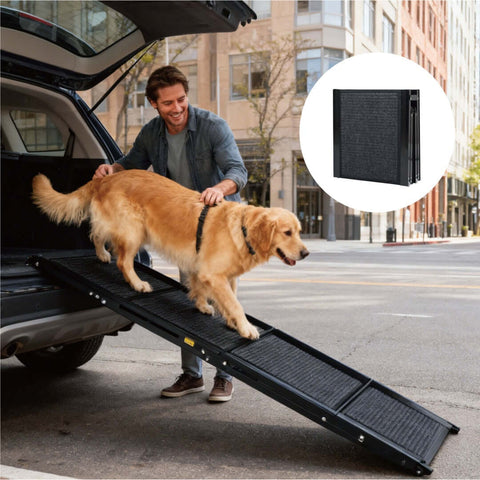
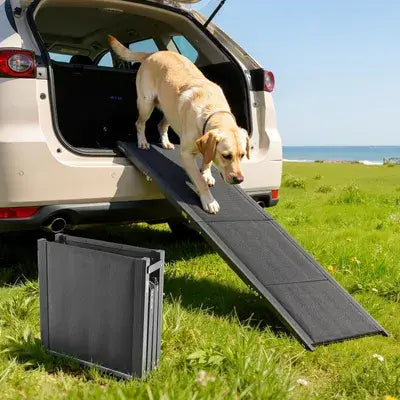
A dog ramp should be at least twice as long as the height it has to reach — that keeps the climb at about 30 degrees, the practical ceiling for most dogs. For a senior or stiff dog, aim closer to 2.4× the height, which brings the slope down to roughly 25 degrees. So a 30-inch SUV trunk needs a ramp of at least 60 inches, while a 34-inch lifted-truck tailgate needs 70 inches or more — and that difference is exactly why so many truck owners buy a short "standard" ramp and watch their dog refuse it.
Below is the math behind that rule, a length-by-vehicle table, and how to measure your own vehicle before you buy.
Ramp length fit checker
Measure from the ground to the edge your dog steps onto. A lifted pickup tailgate is usually 34–40″; a standard SUV cargo floor is 28–36″.
A 71″ ramp gives you a 30° climb
Under the 30° practical ceiling. Fine for a steady dog; a very stiff one may prefer gentler.
With a 71″ Wagisk ramp
30°
With a standard 60″ ramp
36°
The two numbers that set a ramp's steepness
A ramp's climb angle is decided by just two measurements: how high the entry point sits off the ground, and how long the ramp is. Height is fixed by your vehicle. Length is the only lever you control — and it's a powerful one, because every extra inch of ramp flattens the climb without your dog giving up anything in return.
That's also why "dog ramp" is not one product category. A ramp that's perfectly gentle on a sedan becomes a steep scramble against a lifted tailgate. The question is never "is this a good ramp?" — it's "is this ramp long enough for this height?"
Dog ramp length by vehicle (with the actual angles)
Typical entry heights, and what a short 60-inch ramp versus a long 71-inch ramp (the length of both Wagisk ramps) produces at each:
| Vehicle | Typical entry height | Angle with 60" ramp | Angle with 71" ramp | Gentler choice |
|---|---|---|---|---|
| Sedan / car seat | 20–24" | 20–24° | 16–19° | 71" is gentle to spare |
| Crossover / SUV trunk | 26–30" | 26–30° | 22–25° | 71" keeps it walkable |
| Standard pickup tailgate | 30–32" | 30–32° | 25–27° | 71" recommended |
| Lifted / full-size truck tailgate | 34–36" | 35–37° | 29–31° | 71" required |
Two patterns worth noticing. First, a short 60-inch ramp crosses the ~30-degree line right around standard-pickup height — anything taller and you're asking a stiff dog to climb a slope most will refuse. Second, at 71 inches a 34-inch tailgate comes down to about 29 degrees, which is the difference between a refusal and a walk-up. Both Wagisk ramps are 71 inches for exactly this reason — gentler is always better, and length is how you get there.
These are typical figures — your actual angle depends entirely on your measured height, which is why the next section matters more than the table.
Measure before you buy (60 seconds, one tape measure)
Park on flat ground and measure straight down from the loading point to the ground:
- Trucks: ground to the top of the open tailgate.
- SUVs/crossovers: ground to the trunk floor with the hatch open.
- Cars: ground to the seat or cargo floor, whichever your dog uses.
Whatever you measure, a 71-inch ramp keeps the climb gentle — which is why both of ours are built to that length rather than the short 60-inch ramps that get steep on anything truck-height.
Which Wagisk ramp matches your vehicle
Here's the key point: both Wagisk ramps are 71 inches long, so both give the gentle, walkable climb the math above calls for — even on a tall tailgate. Your choice isn't about length; it's about width, weight, and how the ramp anchors.
For SUVs, crossovers, and cars, the heavy duty dog ramp for SUVs is the easy everyday pick. At 17 inches wide and 17.6 lbs it's the narrower, lighter of the two, quad-folds down compact, and adjusts across a wide height range — simple to lift in and out on your own.
For lifted trucks and high tailgates, the TrailRamp™ extra long dog ramp is built for the job. It's wider (19.3 inches) so a large dog feels stable, heavier-duty, and it clips to the tailgate latch so the base stays locked when your dog pushes off at the top — the detail that matters most on a high truck.
Same length, different strengths: choose the SUV ramp for everyday lift-and-carry ease, the TrailRamp for tailgate height and extra width. Compare both side by side in our dog ramps for SUVs, trucks & large dogs collection, or browse the wider senior dog joint & mobility collection. If your dog still hesitates with the right ramp in place, getting a senior dog into the car covers the introduction and training side.
Length gets the ramp used once — stability keeps it used
Length determines whether your dog starts the climb; rigidity, traction, and anchoring determine whether they trust it the second time. A long ramp that flexes at the hinge or slides at the base teaches a cautious senior dog the wrong lesson on day one. For how our two ramps compare spec-by-spec against other heavy-duty options, see the best dog ramps for large dogs roundup — and if your dog loads through a side door or semi cab rather than a tailgate, the height math changes, which we cover in dog ramps for pickup, semi-cab and side-door access. If your dog has already started refusing the truck entirely, the refusal usually has more going on than geometry — we cover the behavioral side, and what to look for in a ramp beyond length, in our guide to getting a senior dog into a truck.
Dog ramp length: quick answers
How long should a dog ramp be for a lifted truck?
At least twice the tailgate height. Lifted and full-size tailgates sit around 34–36 inches, so you need roughly 70 inches of ramp or more. A 71-inch ramp at a 34-inch tailgate keeps the climb near 29 degrees; a standard 60-inch ramp at the same height forces about 34 degrees, which many older dogs refuse.
Is a 60-inch dog ramp long enough for a truck?
Usually not. At a standard pickup tailgate (30–32 inches) a 60-inch ramp already produces a 30–32 degree climb — right at the practical ceiling for most dogs. At lifted-truck height it reaches 35–37 degrees. For any tailgate of 30 inches or more, choose 70 inches of ramp or longer.
What angle should a dog ramp be for a senior dog?
Keep the climb under about 30 degrees, and closer to 25 degrees for a dog that already hesitates on stairs or inclines. The way to get there is length: multiply your measured entry height by 2 for the minimum, or by 2.4 for a stiff or senior dog.
Is a 30-degree dog ramp too steep?
Thirty degrees is the practical ceiling, not a comfortable target. A young, mobile dog can usually manage a 30° climb, but a senior or stiff dog will hesitate or refuse. Aim for 25° or less, and reserve 30° for able-bodied dogs. Length is how you lower the angle — multiply your measured entry height by 2.4 to land near 25° instead of by 2 for the 30° maximum.
How do I measure my vehicle for a dog ramp?
Park on flat ground and measure straight down: trucks from the top of the open tailgate, SUVs from the trunk floor with the hatch open, cars from the seat or cargo floor. Multiply that height by 2 (or 2.4 for a hesitant dog). If the result falls between two ramp sizes, choose the longer one.
One honest caveat
A correctly sized ramp makes vehicle access easier and lower-impact — it supports comfort and everyday mobility, nothing more. It doesn't treat or prevent joint problems, and a sudden change in your dog's willingness to climb or jump is a reason to talk to your vet, not just a reason to buy equipment. Measure your vehicle, size the ramp to the math, and let your vet weigh in on the rest.