Dog Can't Jump Into the Truck Anymore? Here's Why — and How to Get a Senior Dog In
Share
If your senior or large dog has stopped jumping into your lifted truck or tall SUV, it's almost always because the height and angle now ask more of stiff joints than your dog is willing to risk — not because they're being stubborn. The most reliable way to get a senior dog into a truck again isn't lifting 80-plus pounds by hand or adding a step; it's lowering the angle they have to climb, and the simplest way to do that is a ramp long enough for the height of your vehicle. Below is why the jump stops working, why a too-steep ramp gets refused anyway, the angle math that actually matters, and what to look for in a ramp for a tall vehicle.
If your dog's hesitation is new, sudden, or comes with limping, yelping, or general reluctance to move, talk to your vet before anything else. A ramp helps with everyday access; it isn't a substitute for a check-up when something changes quickly.
Why older and large dogs stop jumping in
A jump into a truck is one explosive movement that loads the hips, shoulders, and spine all at once. A few things shift as dogs age or get bigger, and they compound:
- Joints get stiffer and less comfortable. Senior dogs often lose range of motion, so both the push-off and the landing feel harder than they used to.
- Hips and rear-end strength fade. Less muscle in the back legs means less power for the takeoff — the hardest part of the jump.
- Big dogs have farther to fall. A large breed landing badly drops more weight onto one paw, and many dogs avoid that after a single rough landing.
- Hesitation shows up before weakness does. Dogs size up a jump before they commit. Once they link the truck to a near-miss, they often refuse while they're still physically able. The pause is caution, not defiance.
The practical read: a dog that "suddenly can't jump into the truck anymore" is usually making a sensible risk calculation. Make the climb easier and most dogs come back to it faster than any amount of coaxing achieves.
Why a steep ramp gets refused too
Plenty of owners buy a ramp, lean it against a tall tailgate, and watch their dog refuse it anyway. The ramp isn't the problem — the angle is. A short ramp against a tall truck is still a steep climb, and a steep climb asks a stiff dog to push uphill through exactly the joints that are bothering them.
Dogs also judge a ramp visually, the same way they judge a jump. A steep, narrow, or wobbly incline reads as risky, so a cautious senior dog stops at the bottom and won't step on. Two things drive that refusal:
- The incline is too aggressive — the steeper the slope, the more force it demands and the less stable it feels.
- The surface feels unstable — if the ramp flexes, bounces, or slides even slightly, a nervous dog reads it as unsafe and quits partway up.
So "just get a ramp" is incomplete. The ramp has to be long enough to flatten the angle for your vehicle's height, and stable enough that it never moves mid-climb.
How ramp length changes the angle (the part most guides skip)
A ramp's steepness is set by two numbers: how high your tailgate sits, and how long the ramp is. Tailgate height is fixed — so ramp length is the one lever you actually control. For the same height, a longer ramp produces a noticeably gentler climb.
A typical lifted or full-size truck tailgate sits around 34 inches off the ground. Run the geometry at that height:
| Ramp length | Climb angle at a 34" tailgate |
|---|---|
| 60" (standard ramp) | ~34° |
| 71" (extra-long ramp) | ~29° |
That's roughly a 5-degree reduction, and it holds across the lifted-truck range — at a lower 30-inch tailgate a 60-inch ramp still climbs about 30°, while a 71-inch ramp brings it to about 25°.
Five degrees may not sound dramatic, but it's often the exact margin between a slope a stiff senior dog refuses and one they'll walk up without thinking about it. Length is what turns the climb from a scramble into a walk. One honest caveat: the angle depends entirely on your actual tailgate height, so measure ground-to-tailgate before you buy.
Driving something other than a lifted truck? See our full dog ramp length guide by vehicle height.
What to look for in a ramp for a tall vehicle
Once you've decided a ramp is the fix, length is necessary but not sufficient. For a senior or large dog and a tall truck or SUV, these five features decide whether the ramp actually gets used:
- Length matched to your tailgate height. Measure ground-to-tailgate first. For lifted and full-size trucks, that usually means something around 70 inches — not a standard 60-inch ramp that leaves the climb too steep.
- Weight capacity with margin. A ramp rated well above your dog's weight (say, 250 lbs for a large breed) stays solid underfoot instead of shifting when a heavy dog steps on.
- A real grip surface. Smooth molded ridges get slick the moment it rains. A textured, anti-slip surface gives traction your dog can feel on the first step — and that felt grip is what builds their confidence.
- Anti-slide tethering. A clip or carabiner that anchors the ramp to the tailgate stops it sliding when your dog pushes off at the top — the exact moment cheaper ramps move and scare a dog off for good.
- Storage that fits your truck. A ramp only helps if you bring it. Check the folded dimensions and weight against where you'll actually keep it — behind the back seat or upright in the bed.
The right ramp for your vehicle
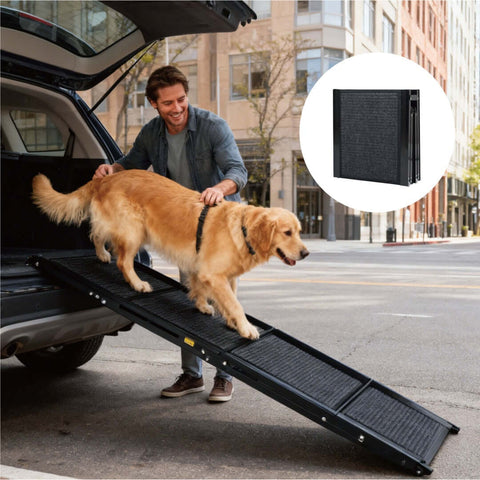
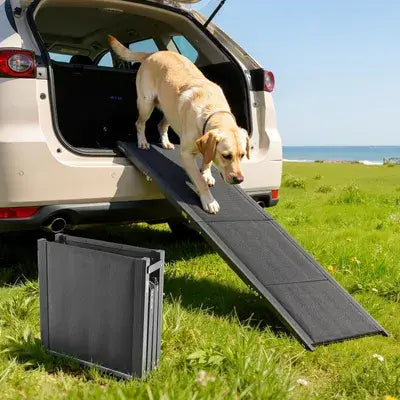
For lifted and full-size pickups, Wagisk's extra long dog ramp for lifted trucks (the TrailRamp™) is built around the math above. At 71 inches it keeps the climb gentle on tall tailgates where a standard ramp stays too steep, its high-strength aluminum frame and locking hinges hold rigid under 250 lbs so there's no flex for a nervous dog to feel, a steel carabiner anchors the base to the tailgate, and the anti-tear fiber traction surface keeps its grip in the wet. It folds to 19.3" × 19.5" × 6.0" and weighs about 20 lbs, so it stows behind the back seat of a full-size pickup.
We'll be straight about fit: that extra length is purpose-built for high-clearance trucks and is overkill for a lower vehicle. If you drive a standard SUV or crossover, the shorter Heavy Duty Dog Ramp for SUVs is the better match — gentle enough at that height, lighter to carry, and easier to store. Measure your tailgate, then choose the ramp that keeps your dog's climb shallow.
See both ramps compared side by side in the dog ramps for SUVs, trucks & large dogs collection.
Two related cases worth knowing: if your dog loads through a side door or semi cab rather than the tailgate, the geometry and anchoring change — that’s covered in dog ramps for pickup, semi-cab and side-door access. And if you’re still comparing ramp types before deciding, start with the best dog ramps for large dogs roundup.
A note on comfort, not diagnosis
A ramp is a comfort-and-access tool. It can make getting in and out of a truck feel easier and lower-risk for a dog whose jumping days are behind them, and many owners notice their dog using it on the first try once the angle is right. It does not treat, cure, or prevent any joint condition, and it isn't a stand-in for veterinary care. If your dog's mobility has changed noticeably, is getting worse, or comes with signs of pain, talk to your vet — they can tell you what's going on and what support, alongside everyday aids like a ramp, makes sense for your dog.
Ramps are one piece of it — the senior dog joint & mobility collection covers supplements and beds built around the same goal.